Our Core Competencies
LINCK combines sawline planning, spare parts and service concepts, process optimization and benchmarking.
.webp)
.webp)
.webp)
What We Can Do at LINCK – and How We Work
In the end, what counts in the plant: yield, throughput, availability. To achieve this, LINCK brings together four core competencies. We plan sawlines and investments so that they fit to the site. We structure service and spare parts to keep downtime under control. We improveprocesses and qualifications within the company. And through benchmarking, we provide the facts on which good decisions are based.
Sawline planning and investment consulting
Lifetime sawline service
Processand production advice
Benchmarking and consulting
Sawline Planning and Investment Consulting
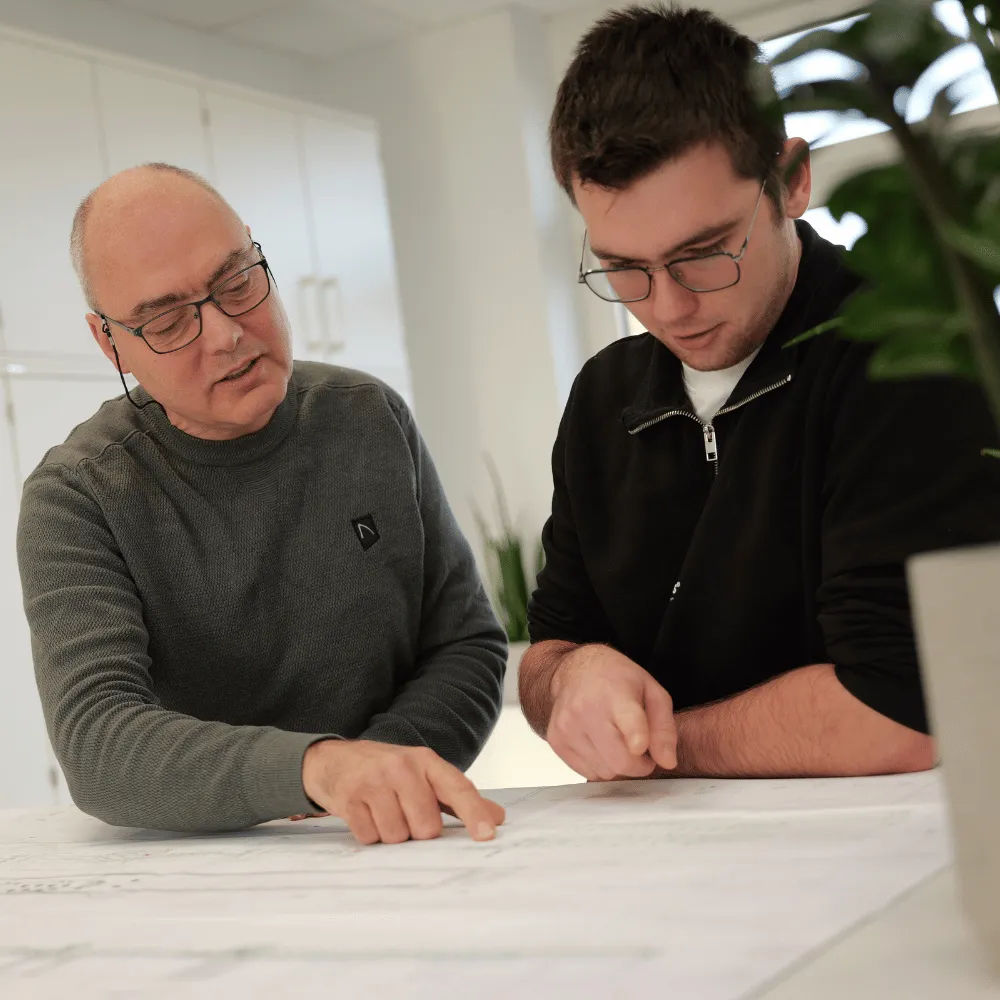
We don't start with a standard solution, but an honest inventory: What is your target? Which raw material really arrives? What framework conditions does the location set? On this, we build a sawline concept thatsuits your company — not the other way around.
As we cover a broad portfolio of sawlines, we can compare variants, size them cleanly and set up the project in such a way that it does not fail due to interfaces later on. On request, we can take over the complete planning and implementation as a general contractor.
And we look at details early on that can really cost money later on: layout, material flow, expandability, logistics, infrastructure. This is not “advice on the side”, but part of our sawline optimization right from the start.
Lifetime Sawline Service
A sawline is only as good as its condition in everyday life. That is why our work does not end with the commissioning. We support sawlines throughout their entire life cycle — with spare parts concepts that are based on real risks: Which parts must always be available, which can wait, which are critical?
We keep over 900,000 spare parts in stock and can also respond with emergency deliveries when necessary. However, it is not only the warehouse that is decisive, but the reliability behind it: clear delivery commitments, defined services and a service structure that grows with you — even when the sawline is getting older.
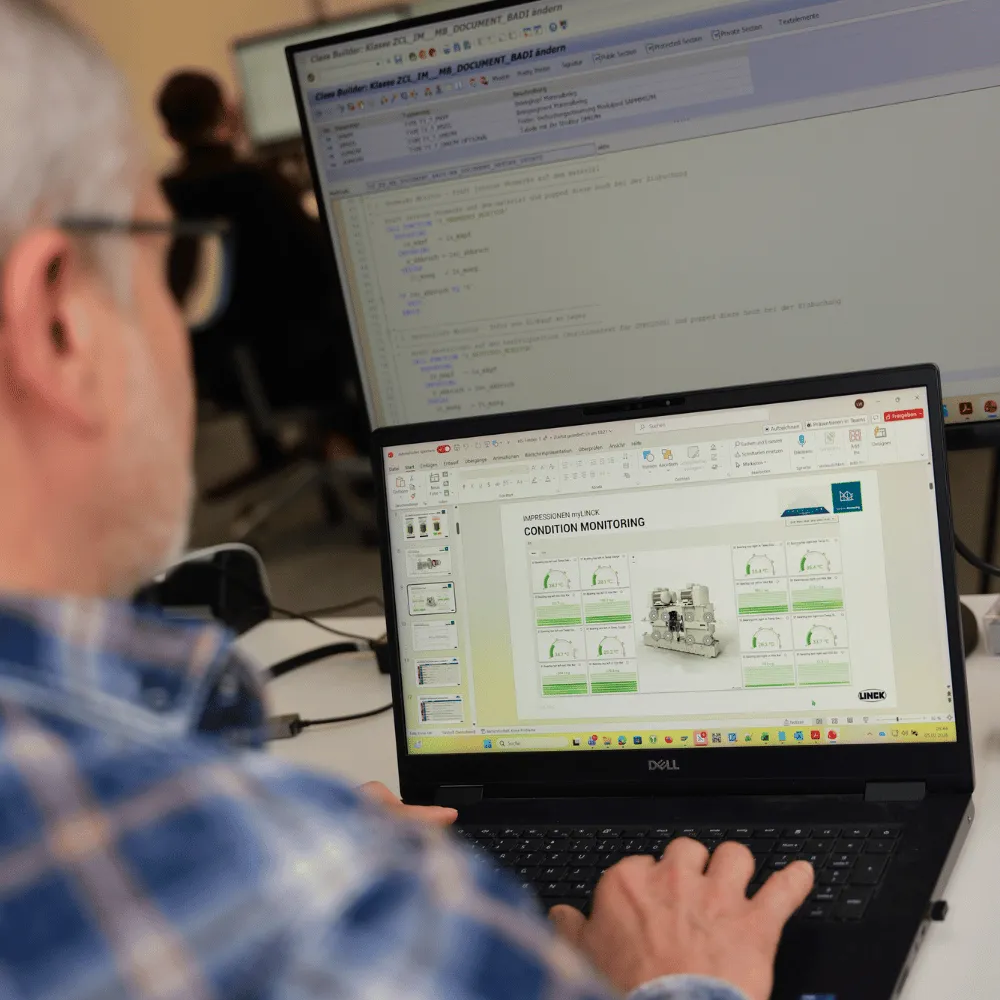
And because many service and maintenance topics are time-consuming in everyday life, we provide digital support via our myLINCK platform — so that information, processes and spare parts topics are available more quickly when it matters.
Process and
Production Advice
If you want more output, it's rarely enoughjust to “make the machine faster.” The key often lies in the process: stability, repeatability, tool condition, operation, sources of interference. We provide consulting on the overall economic optimization of production concepts — not only from a technical perspective, but also with a focus on yield, downtime, quality losses and costs.
Some of this is very pragmatic: We train plant operators so that operational decisions are getting safer and processes run more smoothly. There are also process optimizations and control functions that help identify deviations early on.
myLINCK also plays a role here, too: in the maintenance process, in planning interventions and in tool management — so that maintenance becomes more predictable and less likely happens “on the fly”.
Benchmarking
and Consulting
If you want to improve, you have to know where you stand. We make sawline productivity constantly evaluable and check the effectiveness of the site — not as a game of numbers, but as a diagnosis: Where are you losing time? Where are repetitive errors occurring? Where does the configuration no longer meet your requirements?
Then we compare your sawline with optimized ideal configurations and derive measures that work in real-life operation. Our basis: Experience from over 300 successful large sawmill projects. This helps you prioritize faster — and avoid getting stuck in endless discussions about “nice to have” features.
Our Promise to You!
We do not promise anything that we can’t keep in practice. Instead of general statements, you receive reliable commitments, tailored to the respective sawline, risk and operational reality. That's less show — and more security in the end.
Plant Planning at LINCK:
How Concepts Are Developeded
01
Understanding Values
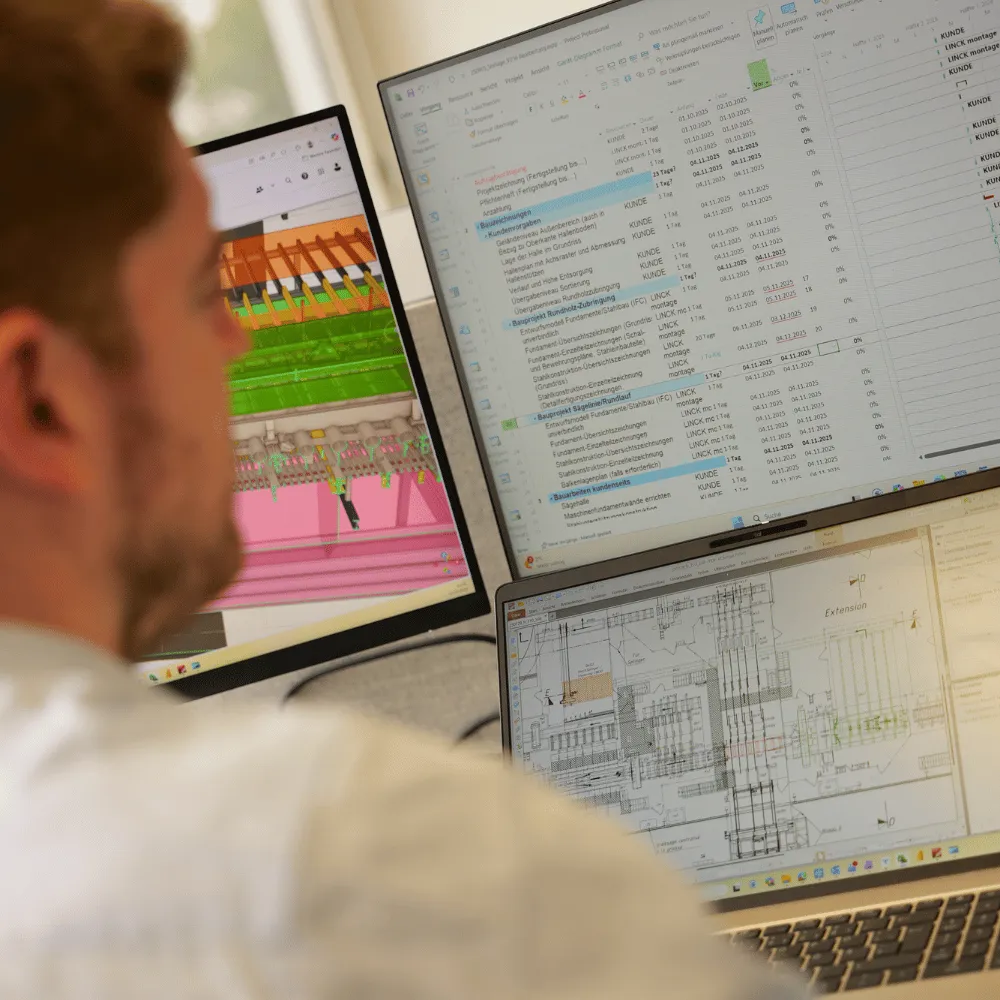
When we plan a sawline, we don't start with the machine, but with the question: Where is value created in your sawmill — and which aspect slows it down today? To answer this, we start into the process together, looking at raw materials, material flow, interfaces and core production processes.
02
Designing Sawlines
In the next step, we translate these requirements into an engineering-based sawline concept. We design the layout, material flows, buffers and cycle times so that they not only work on paper. Where relevant, we validate this mathematically through simulation.
03
Bringing Experience to the Table
An aspect that is underestimated in many projects: Planning reliability does not come from calculations alone, it comesfrom experience. We bring in knowledge from implemented sawlines, particularly in areas where issues typically arise later on: during handovers, at bottlenecks, with tool and quality stability or how the sawline behaves in the event of malfunctions. This shortens discussions and leads more quickly to solutions that are robust in real-life operation.
04
Proving Results
We are working with clearly defined targets to ensure that things don’t end withjust a “feels good” impression. Early on, we define what “success” means in your project — such as maximum yield, stable throughput and efficient use of materials, energy and resources — and derive specific requirements for process management, sawline layout and design.
05
Creating Transparency
Another key element right from the start is operational transparency. We also plan integrated digital features in the machine directly so that performance can be evaluated. This does not mean “digitalization for digitalization’s sake,” but rather data and evaluations that help you to identify, in your day-to-day operations, where performance is being lost — and where targeted optimization is possible.
06
Implementation in Existing Facilities
And because not all projects take place on greenfield sites, we also deal with sawline planning for existing facilities: integration into existing lines, extension and modernization. The guiding principle is simple: as little downtime as possible. We achieve this through well-defined interface planning, clearly structured modification phases and an approach that fits your production — not the other way around.
Contact Us!
This is how you can reach us quickly and easily:
Let us know your concerns at any time.
Telephone
We are happy to be there for you personally.
Location
Appenweierer Str. 46, 77704 Oberkirch (Germany)